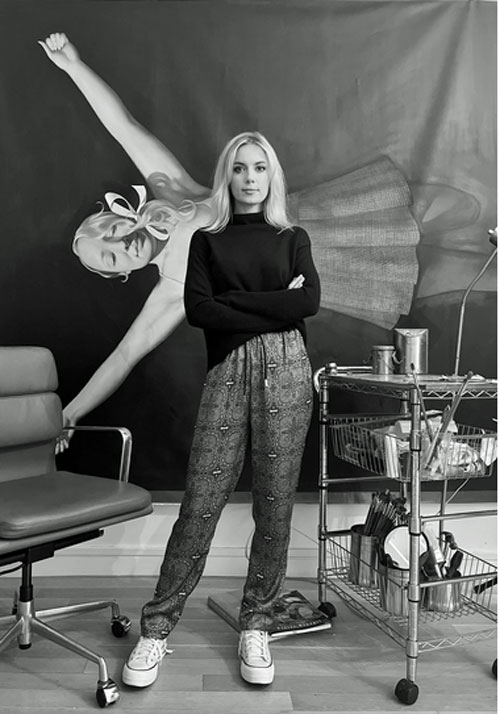
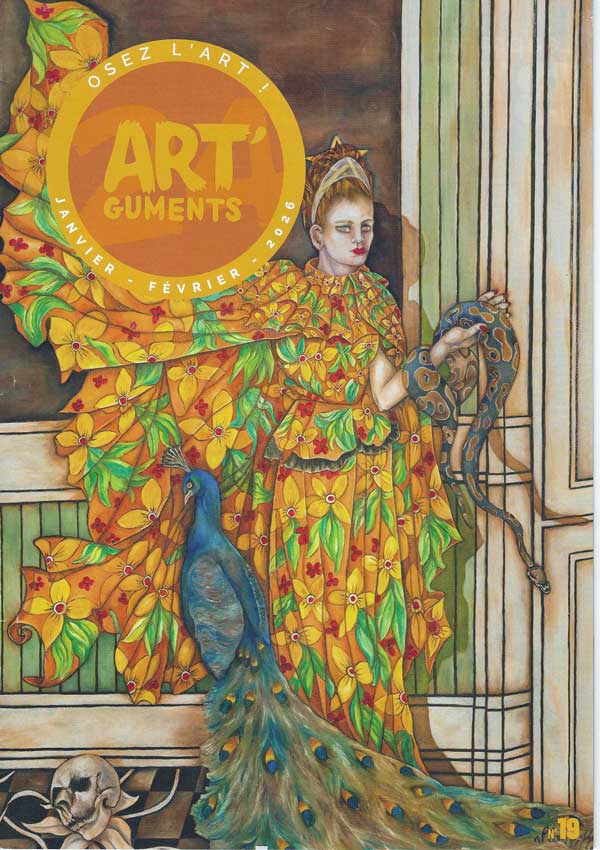
Aude Allonville pose ses pinceaux au Bugue, là où la Dordogne inspire ses toiles, mais son âme reste marquée par ses expériences artistiques passées.
Parisienne d’origine, Aude Allonville a vécu huit ans à Londres. Danseuse, elle baigne dans l’effervescence du monde du spectacle. Cette période a profondément influencé son univers : « l’énergie britannique, ce mélange de classicisme et d’excentricité, est toujours présente dans mon travail », confie-t-elle. De retour en France, elle crée le groupe de rock À l’aise Blaise, avant de se produire en solo sur scène, avec un tour de chant de 28 chansons. La musique et la scène lui ont appris à jouer avec les émotions, à les exacerber. Un jour, à la fin d’un spectacle, elle se rend à une exposition au musée d’art moderne de Paris. « Je prends un véritable coup de poing, un coup de foudre. Une évidence s’impose à moi : je veux faire comme tous ces artistes, devenir peintre. » Son style est reconnaissable entre tous : des drapés tourbillonnants, des couleurs mélangées en fondus transparents, et des superpositions qui créent une belle profondeur. Sa série La fuite du temps en est un parfait exemple, où le surréalisme s’invite pour brouiller les frontières entre réalité et rêve. Les drapés, en particulier, sont au cœur de sa recherche. « Ils me permettent de capturer le mouvement, la richesse du détail, et cette tension entre ordre et chaos. » Chaque toile est une chorégraphie de couleurs et de lumière. « Il faut que ma peinture soit belle et terrible à la fois. Pas de joliesse, pas de superficialité, pas d’explication cohérente », tel est son mantra. Aude puise son inspiration dans des personnages décalés, à la fois poétiques et violents, toujours teintés d’une touche de folie. « Ce sont ces contrastes qui m’intéressent : la douceur et la brutalité, la poésie et le chaos. » Son processus créatif est tout aussi singulier. « Je pose souvent ma toile au pied de mon lit. Parfois, les idées me viennent la nuit, et au réveil, je sais exactement ce que je dois faire. » Une méthode qui donne à ses œuvres une dimension presque onirique, comme si chaque tableau était le fruit d’un dialogue entre conscient et inconscient. Peindre, pour Aude, c’est comme danser ou chanter : une façon de vivre intensément, sans compromis. Ses toiles, à l’huile, sont des invitations à plonger dans un univers où la beauté côtoie l’étrange. Regarder ses tableaux, c’est ressentir quelque chose, même si on ne sait pas toujours quoi. C’est ça, la magie de son art. Voir Le Musée Privé Aude Allonville Colombel Fabrice 8, route de blanquet, 24430 Coursac 06.01.32.23.51 |
Design
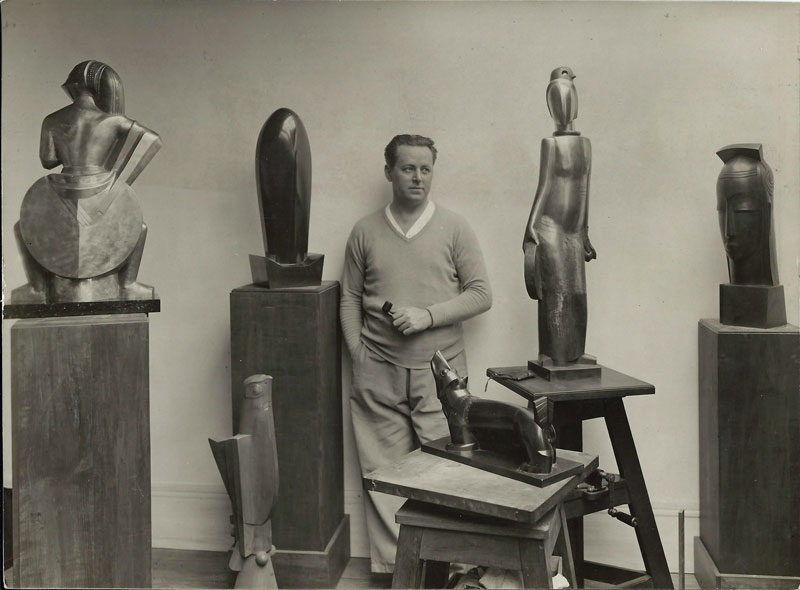
Gustave Miklos et la Hongrie - Un amour unilatéral - texte de Julia Cserba
![]() |
|
La vente de la collection Jacques Doucet en 1972 a permis de redécouvrir l'Art déco aux collectionneurs puis progressivement au grand public. C’est à partir de ce moment que le sculpteur Gustave Miklos, figure emblématique de ce style, vénéré dans les années 1920-1930 et tombé dans l’oubli après la Deuxième Guerre mondiale, retrouve la place qu’il mérite sur la scène artistique internationale. Néanmoins, alors que ses œuvres sont devenues de plus en plus recherchées dans le monde, il est resté pratiquement inconnu jusqu’au début du 21ème siècle dans son pays natal, la Hongrie. Bien que Miklos ait définitivement quitté Budapest en 1909, il a toujours porté la Hongrie dans son cœur. Beaucoup de faits témoignent de son attachement à ses origines hongroises. Toutefois ce sentiment, comme dans le cas de Joseph Csaky, n’était pas réciproque. Quelques éléments complétant l’étude biographique très élaborée de Christiane Patkai permettent de démontrer cette triste réalité. |
Biographie Jean-Paul LALLEMAND
Rosenberg & Co. Françoise Gilot Biography
![]() |
|
Published 15/04/2024 - Born in France in 1921, Françoise Gilot was a remarkable artist whose expansive oeuvre bridged twentieth-century avant-garde and contemporary aesthetics. After completing a degree in English literature in 1938 and briefly attending law school, Gilot began her formal artistic education. In 1941, she began studying with Hungarian painter Endre Rozsda and took classes at the Académie Julian. Two years later during her first gallery exhibition, Gilot met Pablo Picasso. The pair maintained a relationship from 1946 until 1953, during which they had two children, Claude and Paloma. |
![]() |
|
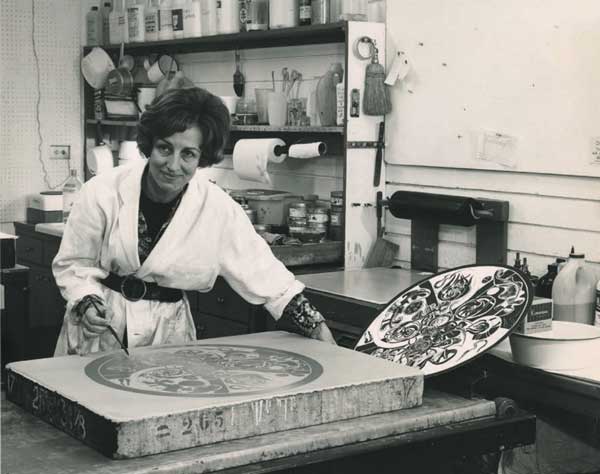
Black and white photograph of Gilot working at the Tanstone Group in LA, 1971. Image courtesy of The Philip and Muriel Berman Museum of Art. |
|
Around 1946, Gilot deserted oil paintings in favor of graphite, and occasionally gouache, on paper. Gilot's early drawings can be seen in the exhibition and range from portraits and still lifes to abstract works in which she explored formal and symbolic transformations obtainable from simple forms. Gilot began accompanying Picasso to Fernand Mourlot's Atelier in 1950, where she became the first woman to make lithographs in the acclaimed studio—Gilot continued printmaking with Mourlot for decades. |
![]() |
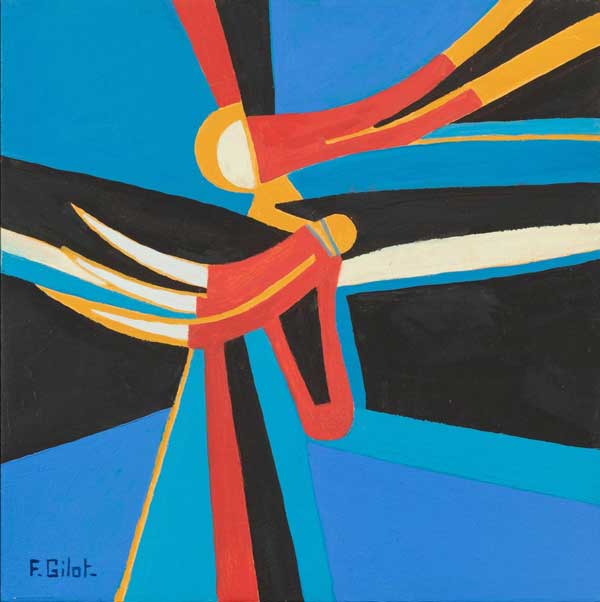
| Françoise Gilot, Incertitude. Oil on canvas, 2003-2004 |
Biography Alexander Archipenko ROSENBERG & Co
| 12-05-2024- Alexander Archipenko (1887–1964) was a Ukrainian born sculptor. Archipenko attended the Kiev Art School to study painting and sculpture. The Byzantine icons, frescoes, and mosaics in Kiev inspired Archipenko's earliest works. After moving to Paris in 1908, he studied at the Ecole des Beaux Arts and frequently visited the Musée du Louvre, where he was drawn to Egyptian, Assyrian, ancient Greek, and early Gothic sculpture. Archipenko began exhibiting with the Cubists and other avant-garde artists at the Salon des Indépendants in 1910, opened his own art school in Paris in 1912, and joined an artist collective circle known as the Section d'Or, a group that included Léger, Braque, Gris, and Picasso. |
![]() |
| Alexander Archipenko working on Torso in Space, 1935; image courtesy of The Archipenko Foundation |
|
Influenced by Picasso and Braque, Archipenko developed a sculptural form of Cubism using interlocking and overlapping solids and sculptural voids to show various views of the figure simultaneously. Archipenko was interested in breaking the figure into geometrical forms and, like the Futurists, sculpted figures in motion. Archipenko's legacy of experimentation is characterized by an unconventional mix of materials such as metal, wood, glass, wire, and paint and mixed media works combining bronze, granite, and turquoise. In 1924, he invented and patented the Archipentura, a new kinetic painting/sculpture mixed media art form. |
Anna Weyant Biography Gagosian Gallery
Anna Weyant Biography
Born in 1995 in Calgary, Alberta, Canada, she is one of the most talented artists of her generation - Thanks to Larry Gagosian, great talent discoverer she is taking an important place among the great creators of our time. Lives and works in New York, NY. - https://gagosian.com/ About Anna Weyant The hapless subjects of Anna Weyant’s indelible paintings and drawings are recurrently tested by everyday circumstances, weathering what the artist has described as “low-stakes trauma.” In these precisely rendered scenes, figures—most often young and female—find themselves embroiled in tragicomic narratives with an ironic twinge, offering a dreamlike insight into the capacity of popular culture and social convention to manufacture and distort gestures, rituals, and signifiers of femininity. But far from presenting her protagonists as merely symbolic, Weyant remains sensitive to their human idiosyncrasies and contradictions, picturing characters who are endearing, mysterious, and wholly themselves. In her crystalline still-life compositions, meanwhile, everyday objects adopt an uncanny, portentous air. Weyant was born in Calgary, Canada, in 1995. After earning a BFA in painting from the Rhode Island School of Design, she relocated to New York, then studied painting at the China Academy of Art in Hangzhou. Moving back to New York, she worked as a studio assistant while pursuing her own practice. Among her first exhibited works is a sequence of darkly cinematic canvases depicting a dollhouse—modeled after one that she owned as a child—and its young female inhabitants. A later series deconstructs the appearance of American suburbia in Lifetime’s made-for-television movies, casting it as a surreal realm in which violence and disaster lurk just beneath the surface. In her still lifes, Weyant depicts fruit, flowers, and other items in a similarly unsettling light; Lily (2021), for example, juxtaposes the titular bloom with a revolver bound in gold ribbon. In these and other works, Weyant employs a somber, muted palette of deep greens, dusty pinks, and deep black. She also draws on art historical and present-day influences, from seventeenth-century Dutch masters such as Frans Hals and Judith Leyster to twentieth-century mavericks like Balthus to contemporary painters Jennifer Packer and Ellen Berkenblit. As revealed in her contributions to group exhibitions including and I will wear you in my heart of heart at FLAG Art Foundation, New York (2021); Artists Inspired by Music: Interscope Reimagined at the Los Angeles County Museum of Art (2022); and Women of Now: Dialogues of Memory, Place & Identity at the Green Family Art Foundation, Dallas (2022), Weyant displays a deep understanding and appreciation of her work’s roots and parallels while eliciting an immediate and emotional response. |
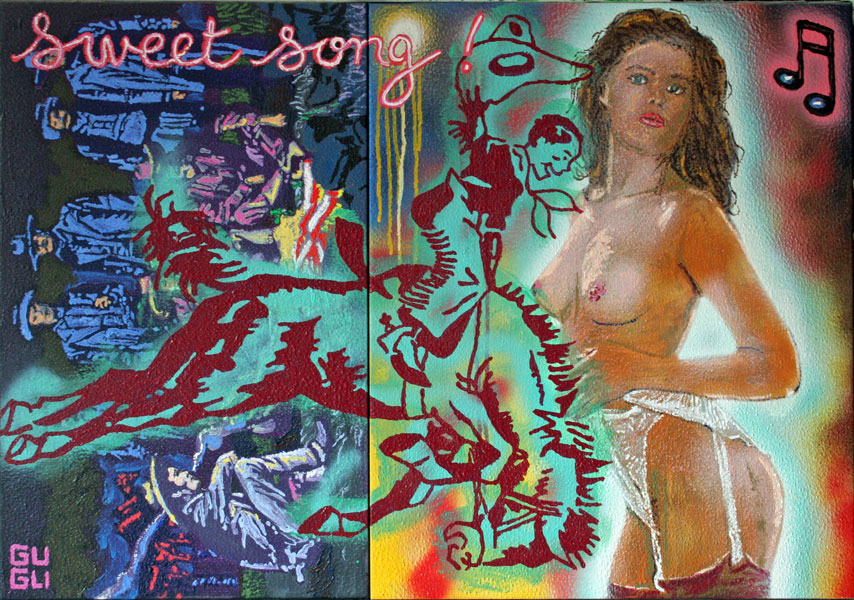
BIOGRAPHIE DE LAURENT GUGLI
Interview de Lionel Sourisseau
|
|
|
Culture Art & Vision X Lapostroff - Studio Kallico Amoureux de couleurs chaudes et de poésie, Lionel Sourisseau a trouvé sa voie en passant de la peinture traditionnelle à la peinture acrylique. En posant un regard coloré sur le monde, ses œuvres étincelantes et bigarrées suscitent la curiosité et stimulent l'imaginaire. Réalisation : Sylvestre Bary Un projet Culture Art & Vision - 2020 - https://www.culture-av.fr |